
Breast Magnetic Resonance Imaging (MRI) is a highly sensitive exam used to detect changes in the breasts, especially in situations where other imaging methods, such as mammography or ultrasound, are not conclusive. It is particularly useful in women at high risk of breast cancer, with dense breasts, or in the context of post-treatment oncological follow-up.
What is Breast MRI?
Breast MRI is an imaging exam that uses magnetic fields and radiofrequency waves to obtain detailed images of the breast tissue. Unlike mammography, it does not use ionising radiation.
Breast MRI does not replace mammography and breast ultrasound, but it is a complementary exam in special situations such as the diagnosis and assessment of the local extent of breast cancer, monitoring chemotherapy, or the assessment of breast implants.
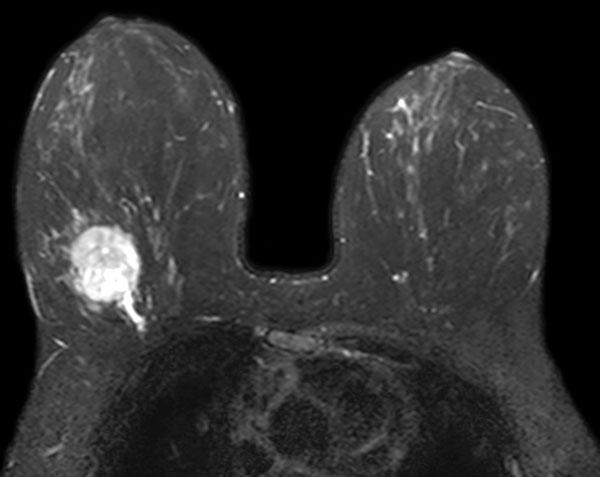
Breast MRI with Contrast
In Breast MRI, intravenous paramagnetic contrast is administered, so it is necessary to puncture your arm or hand to cannulate a peripheral vein. It is a non-iodinated, non-radioactive contrast agent that, through its distribution in the breast tissue, helps to better identify potential lesions/tumours.
What is the price of Breast MRI?
The price of breast MRI is 275€ when performed on a private basis. However, it can also be performed through several agreements, including:
- ADSE: If breast MRI is performed under ADSE, the patient only pays a fee of 30€;
- IASFA, ADM GNR, SAD PSP;
- Insurance companies: Médis, Multicare, Advance Care, Allianz, Saúde Prime, Future HealthCare, SS CGD, SAMS Quadros, SAMS, Montepio, RNA, Generali, Mudum, MGEN, Aegon, Vitória, Una Seguros, other insurers.
- Health plans: Medicare, Saúde Prime, Future HealthCare, Continente Wells, ACP, other health plans.
- Protocols: NRD has protocols with several clinics and institutions that allow you to undergo the exam at very competitive prices. For breast MRI, the price through protocol is 220€.
The price varies depending on the healthcare system or insurance you wish to use.
Find out more about the price of MRI exams.
How is it performed?
As mentioned above, Breast MRI is performed with intravenous contrast administration, so we will start by puncturing your arm or hand to cannulate a peripheral vein.
The patient is then positioned lying face down, with the chest placed in specific cavities of the dedicated breast coil. Your arms will be placed above your head and your head will be supported to the side.
It is essential to remain still during the procedure to ensure clear and accurate images.
We will provide you with earplugs to reduce the perception of scanner noise.
The MRI scanner is open at both ends.
After acquisition of the various sequences and their reconstruction, a detailed analysis of the images is required, as well as their manipulation to obtain reformatted views and quantitative and qualitative assessment of gadolinium uptake by the tissues, so that the radiologist can make a diagnosis.
Correlation will always be made with the other imaging methods used in breast studies, such as mammography, ultrasound and even previous biopsies.

What does it detect?
Breast MRI allows the detection of:
- Suspicious nodules not visible with other imaging techniques;
- Breast cancer (in early stages or recurrences);
- Extent of tumour lesions before surgery;
- Changes in dense breasts or in breasts with implants;
- Complications associated with breast implants (rupture, contracture);
- Benign lesions (fibroadenomas, complex cysts);
- Post-surgical or inflammatory changes;
- Among others.
In which cases is it indicated?
Breast MRI may be recommended by your doctor in the following situations:
- Assessment of women at high risk of breast cancer (e.g. BRCA1/2 mutations);
- Assessment of lesions not clarified by mammography/ultrasound;
- Surgical planning in oncology patients;
- Assessment of the response to neoadjuvant chemotherapy;
- Assessment of breast implants and detection of ruptures;
- Follow-up after surgery or radiotherapy;
- Among others.
Preparation and guidelines for Breast MRI
Before undergoing an MRI at NRD, please consider the following:
| Topic | Guidance |
| Exam prescription (paper copy) | You must bring the exam prescription in paper form. |
| Fasting | Breast MRI is performed with contrast, so fasting is generally required for about 4 hours before the exam (we will inform you when booking). |
| Menstrual cycle | If you are still menstruating, please inform us so that your exam can be scheduled according to your menstrual cycle: it should preferably be carried out between the 7th and 14th day of the cycle. |
| Early arrival | Arrive 15 minutes before the scheduled time. |
| Medication | You may take essential and unavoidable medication with a minimum amount of water. |
| Metal objects | Remove all metal objects (e.g. earrings, bracelets, necklaces, piercings, hairpins, removable prostheses, etc.). |
| Pregnancy | Inform the NRD healthcare professional if you are pregnant. |
| Exams / Tests / Info | Bring previous imaging exams, relevant clinical information and recent laboratory tests. Inform us about surgeries, chemotherapy, implants or a family history of breast cancer. |
| Glucose monitoring implant | Do not place the implant, as it will have to be removed before the exam. |
| Make-up | Do not wear make-up, as some products may affect the exam. |
| Valve and/or orthopaedic prostheses | If you have valve and/or orthopaedic prostheses, bring proof describing and specifying the material composition. |
| Hearing aids | Inform us if you use a hearing aid, as it must be removed before the exam. |
| Dental prostheses | Inform us if you use a dental prosthesis, as it must be removed before the exam. Also inform us if you have dental implants. |
| Orthodontic appliances | Inform us if you wear orthodontic appliances. A test may be necessary to assess compatibility with MRI. |
| Pacemakers and implantable devices | NRD does not perform MRI exams on people with pacemakers or implantable devices (e.g. cochlear implant), and it is recommended that the exam be carried out in a hospital setting. |
Throughout the MRI exam, you will be continuously monitored by the NRD imaging technologist responsible for your exam. An alert system will also be at your disposal, which you can activate if needed.
You should remain still during the exam to ensure high-quality images.
The entire NRD team will be at your disposal to answer any questions that may arise.
After the exam, you can return to your usual daily activities.
When and how do you receive the results?
You will receive the MRI results within 7 days after the exam, by email or in paper form at the clinic. On the day of the exam, you will take a CD with the images with you.
Where can you have it done?
The MRI can be performed at NRD, at the following address:
Avenida Columbano Bordalo Pinheiro, nº 11-B, r/c, 1070 – 060 Lisbon (near Praça de Espanha)